Microwulf Is The World’s Cheapest Supercomputer, A Personal, Portable Beowulf Cluster
If there ever comes a time when you find yourself in the need of a
supercomputer, would you fancy making one for yourself or will you spend
insane cash on purchasing one? We know we’d go for building it on our
own. We know one person who’d agree with this approach; the same guy who
has created this supercomputer known as Microwulf that has qualified
for the cheapest supercomputer ever build.

The system is a Beowulf cluster that is capable of running at 26.25
Gigaflops and costs $1,256. This may not qualify for a budget computer,
but for budget supercomputer it sure is heck of a solid candidate. The
figure of 26.25 Gigaflops is insane when you look at it from
price/performance ratio.

Sun’s Spart Enterprise M9000 Supercomputer costs $511,385 and is
capable of working at 1.03 Teraflops, breaking this in dollars per
Gigaflop tells us that M9000 costs $496 per Gigaflop whereas Microwulf
costs $48 per Gigaflop.
You can find out how to make your own mini-supercomputer by checking
Cluster Monkey out!
Microwulf: Design
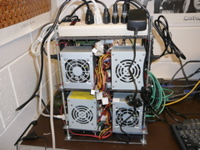
Microwulf is designed to be a cost-efficient,
high performance, portable, "personal" Beowulf cluster.
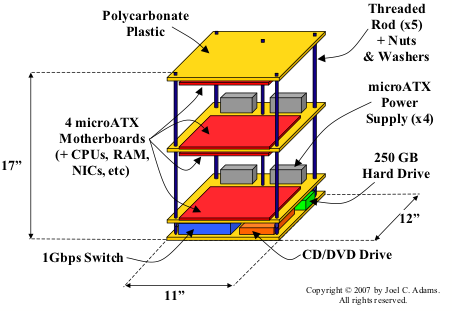
The basic idea is to pack a lot of processing power into a
small volume using multicore CPUs.
|
To do so, we use motherboards with
a smaller form-factor
(like Little Fe)
than the usual ATX size,
and we space them using threaded rods
(like this cluster)
and scrap plexiglass, to minimize "packaging" costs.
By building a "double decker sandwich" of
four microATX motherboards, each with
a dual core CPU and
2 GB RAM (1 GB/core),
we can build a 4-node, 8-core, 8GB multiprocessor
small enough to fit on one's desktop,
powerful enough to do useful work,
and inexpensive enough that anyone can afford one.
Since our microATX motherboards have an on-board Gigabit Ethernet
adaptor, that is the least expensive way for the processors
to communicate.
To keep the two cores from competing for this adaptor,
we add a second Gigabit Ethernet adaptor in each motherboard's
PCI-Express slot.
We then rely on Open MPI (see below)
to spread the communication load across these two adaptors.
Then we connect all the adpators via
an inexpensive 8-port Gigabit Ethernet switch.
This provides a Gigabit Ethernet link's worth of bandwidth
for each core.
|
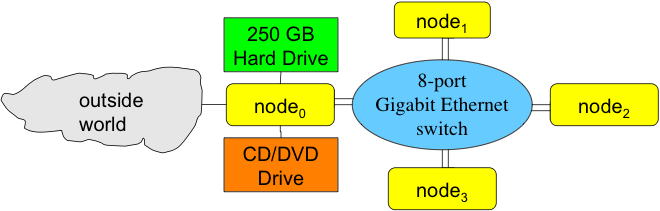
The bottom motherboard acts as the "master" node,
which is configured to boot from Microwulf's single hard disk
(and/or DVD-ROM drive).
The other three motherboards are configured as "server" nodes,
and boot from the network using PXE.
The following schematic diagram shows the interconnections between
Microwulf's components:
At present, Microwulf is running
Ubuntu Linux.
Microwulf Pictures

Tim Brom and Microwulf
|
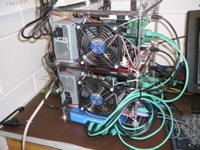
Microwulf "west" view
|
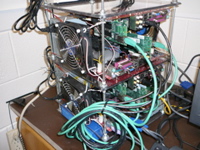
Microwulf "southwest" view
|
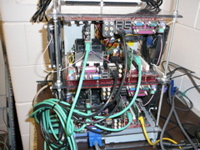
Microwulf "south" view
|
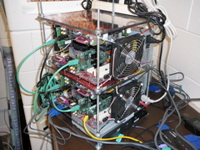
Microwulf "southeast" view
|
|
Microwulf: Cost Efficiency
When you have measured a supercomputer's performance using HPL,
and know its price, you can measure its cost efficiency
by computing its
price/performance ratio.
By computing the number of dollars you are paying for each
floating point operation (flop),
you can compare one supercomputer's cost-efficiency against others.
With a price of just $2470
and performance of 26.25 Gflops,
Microwulf's price/performance ratio (PPR)
is $94.10/Gflop, or less than $0.10/Mflop!
This makes Microwulf
the first general-purpose Beowulf cluster to break
the $100/Gflop (or $0.10/Mflop) threshold
for measured double-precision floating point performance.
For comparison purposes:
-
In 1976,
the Cray-1
cost more than 8 million dollars
and had a peak (theoretical maximum) performance of 250 Mflops,
making its PPR more than $32,000/Mflop.
Since peak performance exceeds measured performance,
its PPR using measured performance
(estimated at 160 Mflops) would be much higher.
-
In 1985,
the Cray-2
cost more than 17 million dollars
and had a peak performance of 3.9 Gflops,
making its PPR more than $4,350/Mflop ($4,358,974/Gflop).
-
In 1997,
IBM's Deep Blue
defeated world chess champion Gary Kasparov.
Its price has been estimated at 5 million dollars,
and it produced 11.38 Gflops of measured performance,
making its PPR more than $439,367/Gflop.
-
In 2003, the U. of Kentucky's Beowulf cluster
KASY0
cost $39,454 to build,
and produced 187.3 Gflops on the double-precision version of HPL,
giving it a PPR of about $210/Gflop.
-
Also in 2003, the University of Illinois at Urbana-Champaign's
National Center for Supercomputing Applications built
the PS 2 Cluster
for about $50,000.
No measured performance numbers are available;
which isn't surprising, since the PS-2 has no hardware support for double
precision floating point operations.
This cluster's theoretical peak performance is about 500 Gflops
(single-precision); however,
one study
showed that the PS-2's double-precision performance took
over 17 times as long as its single-precision performance.
Even using the inflated single-precision peak performance value,
its PPR is more than $100/Gflop;
it's measured double-precision performance is probably more than 17 times that.
-
In 2004, Virginia Tech built
System X,
which cost 5.7 million dollars,
and produced 12.25 Tflops of measured performance,
giving it a PPR of about $465/Gflop.
-
In 2007, Sun's Sparc Enterprice M9000
with a base price of $511,385,
produced 1.03 Tflops of measured performance,
making its PPR more than $496/Gflop.
(The base price is for the 32 cpu model,
the benchmark was run using a 64 cpu model,
which is presumably more expensive.)
At $94.10/Gflop, Microwulf is by far the most cost-efficient platform
available today for high performance double-precision computation.
While it may not provide Tflop performance, it provides more than twice
the general-computation performance of Deep Blue.
Microwulf thus offers significant computational power at a
highly affordable price.